
On 31 July 2011, the Aventador was reviewed by the motorsport show Top Gear. Host Richard Hammond was impressed with the performance and handling of the car. His biggest complaint was a nostalgic poke at the Aventador's accessible temperament, implying that it left him longing for the "danger" associated with driving previous Lamborghini supercars. [25] The Aventador posted the third fastest time ever recorded on the Top Gear track with a time of 1.16.5, handily beating not only the monstrous $2mil Bugatti Veyron Super Sport, The Ferrari Enzo and the Porsche GT3, but an extensive list of A-list supercars from around the world. In episode 18 of the program cohost Jeremy Clarkson says the Aventador is the best alternative to the Ferrari 458 Italia, describing it as being "£200000 worth of dreams." [26]
The Lamborghini Aventador makes an appearance on video games such as Gran Turismo 5 via confirmed downloadable content, Forza Motorsport 4 via the November Speed Pack DLC, Car Town, Forza Horizon, Need for Speed: The Run, and was heavily featured in Need for Speed: Most Wanted (2012). It also served as the cover art of the PlayStation Vita game Asphalt: Injection and iOS game Asphalt 7: Heat.


LAMBORGHINI AVENTADOR J

Six months after unveiling the Aventador, plans for a roadster version were leaked by the U.S. EPA after it included the model on a data sheet on its website. Lamborghini officially unveiled the Aventador J to the world at the 2012 Geneva Motor Show.[27] The roofless and windowless concept car uses the same V12 engine as the standard Aventador, producing 700 hp through a lightweight seven-speed automated transmission. The car has also been stripped of its air conditioning and radio units to save further weight, allowing it to weigh in at only 3,472 pounds (1,575 kg).[28][29] The car presented at the Geneva show was the only unit to be produced, and was sold for US$2.8 million. Another Limited Edition model was made for Yahyaa Shaikh and was sold at an unknown price. The car was specially made for a close relation.[30][31]
The J designation was thought to have come from Appendix J in the FIA rulebook that describes the technical specifications of race cars.[30] However during an interview with designer Filippo Perini, it was revealed that the 'J' actually stands for Jota, in reference to 1970's one off Lamborghini Miura Jota which also conformed the FIA's Appendix J regulations.
Mansory Carbonado
In July 2012 Mansory unveiled the Carbonado, a modified version of the Aventador. It features the same 6.5 litre V12 engine as the normal Aventador, but it has been tweaked to produce 754 PS (555 kW; 744 bhp) @ 8,300 rpm, a 54 PS (40 kW; 53 bhp) increase on the standard model. The torque has also been improved—the engine now produces 750 N·m (550 lb·ft) @ 6,000 rpm, a 60 N·m (44 lb·ft) advantage. Because of the extra power, the performance figures are slightly higher: 0–60 takes 2.8 seconds and the top speed is on the far side of 220 mph (350 km/h). The exterior of the vehicle is covered in black carbon fibre, which is why Mansory call it "the Black Diamond of the streets". Six units will be made.[32]Production Roadster
Spy pictures published in Autocar magazine in October 2012 show an Aventador roadster variant in development, thought to be using a two-piece carbonfibre roof rather than a removable soft-top.[33]Aventador AU79
In June 2012, Lamborghini Miami released a special-edition gold-chrome plated Aventador AU79. Brett David, owner of Prestige Imports, told Huffington Post that it took 70 days to complete the car with gold foil at Auto Supershield at Boca Raton. It is estimated to be at $550,000USD[34]DMC Molto Veloce LP900
In May 2012 DMC Exotic Car Tuning from Germany unveiled the Molto Veloce LP900, a modified version of the Aventador. It features a modified 8.1 litre V12 engine, which has been tweaked to produce 900 PS (660 kW; 890 bhp), a 200 PS (150 kW; 200 bhp) increase on the standard model. Because of the extra power, the performance figures are slightly higher: 0–60 takes 2.7 seconds and the top speed is on the far side of 230 mph (370 km/h). The exterior features front & rear diffusers made of carbon fibre. [35]
 PORSCHE PANAMERA

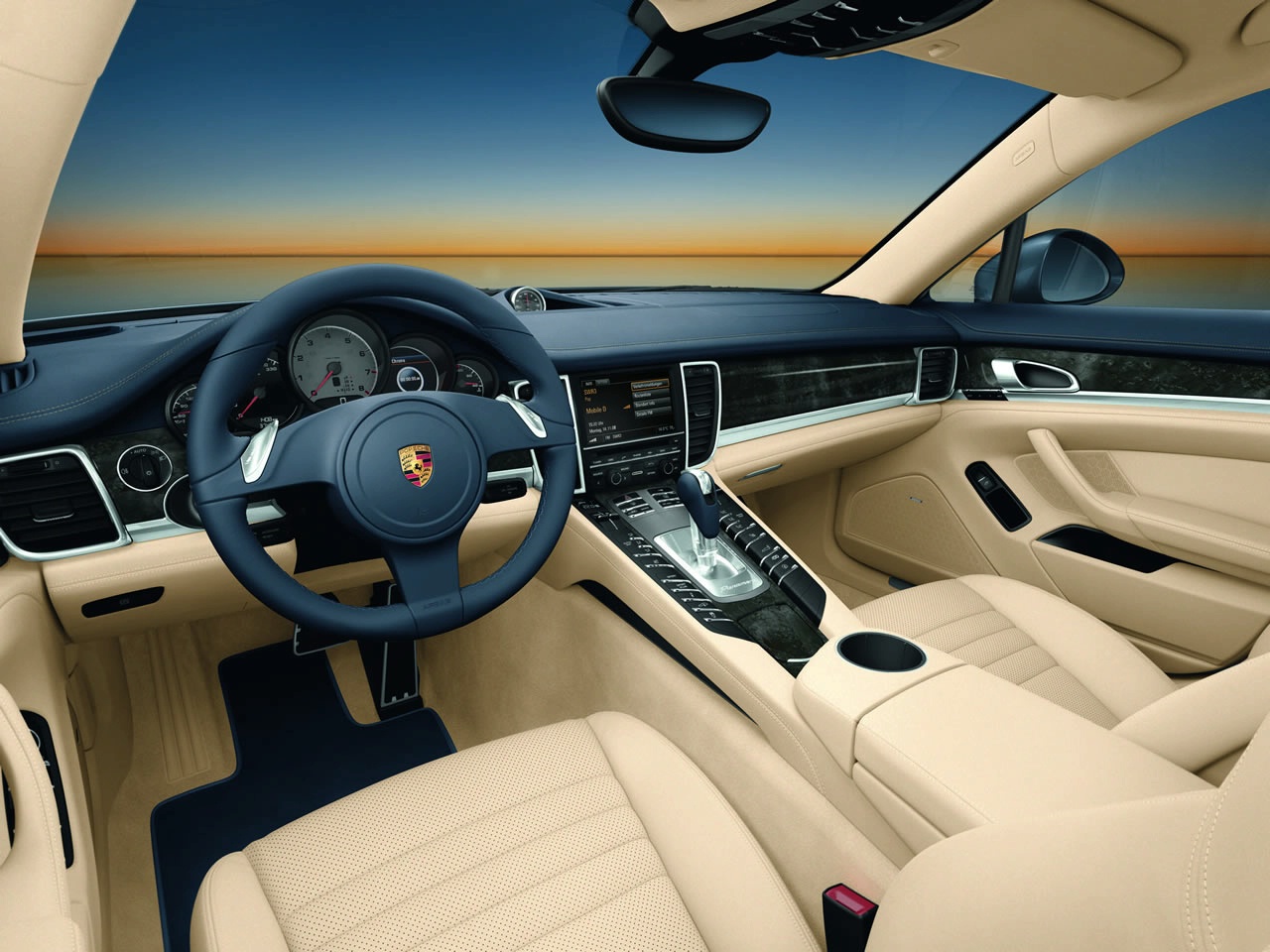

The Panamera is marketed as a more exciting and higher performing alternative to the traditional executive saloons such as the BMW 7 Series, the Audi A8, and the Mercedes-Benz S-Class. The Panamera competes more directly with cars such as the Maserati Quattroporte, Mercedes-Benz CLS-Class, BMW 5 Series Gran Turismo[8][9] and Aston Martin Rapide.[10]
Like the Porsche Cayenne SUV (which has become the marque's best-selling vehicle), the Panamera upset many Porsche purists, since it was seen as an attempt to broaden Porsche's appeal beyond that of hardcore fans. The Panamera ran contrary to the company's signature offerings, particularly its light two-door rear-engine sports cars like the 911. The Panamera on the other hand is considered a full-size luxury car, weighing at nearly 4,000 pounds (1,800 kg), with four doors, and its engine mounted in the front. The Panamera's appearance with its long hood and rear hatch bears little resemblance to a stretched 911, although it does resemble the 911 from certain angles.[11] The iconic 911 has a sparse interior, as it was focused on raw performance, while the Panamera has a sumptuous interior loaded with modern technological amenities and expensive leather upholster
Engines
| car model | displacement & configuration |
max. motive power @ rpm | max. torque @ rpm |
|---|---|---|---|
| Panamera, Panamera 4 |
3.6 litre V6 | 300 bhp (224 kW; 304 PS) @ 6,200 | 400 N·m (295 lbf·ft) @ 3,750–4,250 |
| Panamera Diesel | 3.0 litre V6 turbodiesel | 250 bhp (186 kW; 253 PS) @ 3,800 | 550 N·m (406 lbf·ft) @ 1,750–2,750 |
| Panamera S, Panamera 4S |
4.8 litre V8 | 400 bhp (298 kW; 406 PS) @ 6,500 | 500 N·m (369 lbf·ft) @ 3,500–5,000 |
| Panamera GTS | 4.8 litre V8 | 430 bhp (321 kW; 436 PS) @ 6,700 | 520 N·m (384 lbf·ft) @ 3,500–5,000 |
| Panamera S Hybrid | 3.0 litre V6 supercharged | 380 bhp (283 kW; 385 PS) @ 5,500 | 580 N·m (428 lbf·ft) @ 3,000–5,250 |
| Panamera Turbo | 4.8 litre V8 twin turbo | 500 bhp (373 kW; 507 PS) | 700 N·m (516 lbf·ft) @ 2,250–4,500 |
| Panamera Turbo S | 4.8 litre V8 twin turbo | 550 bhp (410 kW; 558 PS) @ 6,000 | 750 N·m (553 lbf·ft) @ 2,250–4,500 |
Transmissions
The new 7-speed ZF Friedrichshafen PDK dual clutch transmission is standard on the Panamera 4, 4S and Turbo models.[22][23] With the addition of the optional sport chrono package, this provides faster acceleration times. In some markets a 6-speed manual is available for rear-wheel drive petrol versions. The S Hybrid and Diesel models come only with an Aisin-supplied 8-speed automatic transmission called Tiptronic S.Panamera Turbo
- Drag Coefficient: 0.30[24]
- 0–60 mph (0–97 km/h): 3.0 seconds[24]
- 0–100 mph (0–160 km/h): 7.2 seconds [24]
- 1/4 mile: 10.1 seconds @ 114 mph (183 km/h) [24]
- Top Speed: 193 mph (311 km/h) [24]
- Braking 70 mph (112.6540800000000 km/h) to 0 mph (0 km/h): 159 feet (48 m) [24]
| Gear | mph | km/h | rpm |
|---|---|---|---|
| 7th | 193 | 311 | 4450 |
| 6th | 193 | 311 | 6100 |
| 5th | 169 | 272 | 6600 |
| 4th | 123 | 198 | 6600 |
| 3rd | 84 | 135 | 6600 |
| 2nd | 51 | 82 | 6600 |
| 1st | 28 | 45 | 6600 |
Panamera S Hybrid

Versions and modifications
Bugatti Veyron (2005–2011)
Specifications and performance


The car's wheelbase is 2,710 mm (106.7 in). Overall length is 4,462 mm (175.7 in) which gives 1,752.6 mm (69.0 in) of overhang. The width is 1,998 mm (78.7 in) and height 1,204 mm (47.4 in). The Bugatti Veyron has a total of ten radiators:[15]
- 3 heat exchangers for the air-to-liquid intercoolers.
- 3 engine radiators.
- 1 for the air conditioning system.
- 1 transmission oil radiator.
- 1 differential oil radiator.
- 1 engine oil radiator
Engine output
According to Volkswagen Group and certified by TÜV Süddeutschland, the final production Veyron engine produces 1,001 metric horsepower (736 kW; 987 bhp) of motive power, and generates 1,250 newton metres (922 lbf·ft) of torque.[1][18] The nominal figure has been stated by Bugatti officials to be conservative, with the real total being 1,020 metric horsepower (750 kW; 1,006 bhp) or more.Top speed
German inspection officials recorded an average top speed of the original version of 408.47 km/h (253.81 mph)[5] during test sessions on the Ehra-Lessien test track on 19 April 2005.This top speed was verified by James May on Top Gear in November 2006, again at Volkswagen Group's private Ehra-Lessien test track. May noted that at top speed the engine consumes 45,000 litres (9,900 imp gal) of air per minute (as much as a human breathes in four days). The Veyron at the time had the highest top speed of any street legal production car. Back in the Top Gear studio, co-presenter Jeremy Clarkson commented that most supercars felt like they were shaking apart at their top speed, and asked May if that was the case with the Veyron at 407 km/h (253 mph). May responded that no, the Veyron was very controlled, and only wobbled a tiny bit when the air brake deployed. May further commented, “Absolutely yeah, it’s totally undramatic. But I would give you a bit of a warning: It’s a bit disorientating doing that sort of speed, because after I came off the banking, I was slowing down to stop, and you know how you get a bit impatient and think ‘I’ll just open the door’; fortunately I looked back at the speedo, and I was still doing seventy.”[19]
The car's everyday top speed is listed at 350 km/h (220 mph). When the car reaches 220 km/h (140 mph), hydraulics lower the car until it has a ground clearance of about 9 cm (3.5 in). At the same time, the wing and spoiler deploy. In this handling mode the wing provides 3,425 newtons (770 lbf) of downforce, holding the car to the road.[15]
For top speed mode the driver must, while stationary, toggle a special top speed key to the left of the driver's seat. A checklist then establishes whether the car and its driver are ready to attempt to reach 407 km/h (253 mph). If so, the rear spoiler retracts, the front air diffusers shut, and normal 12.5 cm (4.9 in) ground clearance drops to 6.5 cm (2.6 in).
Braking
The Veyron's brakes use cross drilled, radially vented carbon fibre reinforced silicon carbide (C/SiC) composite discs, manufactured by SGL Carbon, which have a much greater resistance to brake fade when compared with conventional cast iron discs. The lightweight aluminium alloy monobloc brake calipers are made by AP Racing; the fronts have eight[15] titanium pistons and the rear calipers have six pistons. Bugatti claims maximum deceleration of 1.3 g's on road tyres. As an added safety feature, in the event of brake failure, an anti-lock braking system (ABS) has also been installed on the handbrake.Prototypes have been subjected to repeated 1.0 g braking from 312 km/h (194 mph) to 80 km/h (50 mph) without fade. With the car's acceleration from 80 km/h (50 mph) to 312 km/h (194 mph), that test can be performed every 22 seconds. At speeds above 200 km/h (120 mph), the rear wing also acts as an airbrake, snapping to a 55° angle in 0.4 seconds once brakes are applied, providing an additional 0.68 g (6.66 m/s2) of deceleration (equivalent to the stopping power of an ordinary hatchback).[15] Bugatti claims the Veyron will brake from 400 km/h (250 mph) to a standstill in less than 10 seconds, though distance covered in this time will be half a kilometer (third of a mile).[15]
Specifications
| Basic Specifications[1][2] | |||
|---|---|---|---|
| Layout and body style | Mid-engine, four-wheel drive, two-door coupé/targa top | Base price | €1,225,000 (GB£1,065,000/US$1,700,000) Super Sport: €1,912,500 (GB£1,665,000/US$2,700,000) |
| Internal combustion engine | 8.0 litre W16, 64v 2xDOHC quad-turbocharged petrol engine | Engine displacement and max. power |
7,993 cc (487.8 cu in) 1,001 metric horsepower (736 kW; 987 bhp) Super Sport: 1,200 metric horsepower (883 kW; 1,184 bhp) |
| Performance | |||
|---|---|---|---|
| Top speed | 408.47 km/h (253.81 mph) (average) Super Sport: 431.072 km/h (267.856 mph) (average) |
||
| 0–100 km/h (0.0–62.1 mph) | 2.46 seconds | 0–240 km/h (0.0–149.1 mph) | 9.8 seconds |
| 0–300 km/h (0.0–186.4 mph)[20] | 14.6 seconds | 0–400 km/h (0.0–248.5 mph)[21][22][not in citation given] | 55 seconds |
| Standing quarter-mile (402 m)[23] | 10.2 seconds (standard), 9.9 seconds | ||
| Braking | 31.4 m (from 100 km/h to 0) | ||
| Fuel economy[24] | |||
|---|---|---|---|
| EPA city driving | 8 miles per U.S. gallon (29 L/100 km; 9.6 mpg-imp) | EPA highway driving | 14 miles per U.S. gallon (17 L/100 km; 17 mpg-imp) |
| Top speed fuel economy | 3 miles per U.S. gallon (78 L/100 km; 3.6 mpg-imp), or 1.4 U.S. gal (5.3 L; 1.2 imp gal) per minute | ||
Special versions
Pur Sang (2007)
Launched on 11 September 2007 at the Frankfurt Motor Show the "Pur Sang"[25] (literally Pure Blood, but more accurately translated as Thoroughbred) is a limited run of five cars.[26] They have high-gloss bronze roadwheels with a diamond-cut glass-like finish and a clear body finish revealing the Veyron's silver oxide finish carbon fibre body, but are otherwise standard finish.
|


Pegaso (2007)
This special edition Veyron was made for a rich Ukrainian living in Dubai. Some reports say that the Pegaso had its power increased from 1,001 PS (736 kW; 987 bhp) to 1,200 PS (880 kW; 1,200 bhp), making it as powerful as a Super Sport. The Pegaso name comes from a Spanish coachbuilder that used to build luxury cars, such as the Pegaso Z-102.[27]Fbg Par Hermès (2008)
A Hermès-themed model: Hermès monogram on the front grille, roadwheels with a single H in the centre, and fuel filler door engraved with Bugatti Veyron Fbg Par Hermès. The interior is done in Hermès leather with internal door handles reminiscent of handles used on Hermès trunks – and a Hermès wallet and Hermès suitcase is included.[28][29]
|

Sang Noir (2008)
A limited run of 15 cars[30] with an all-black exterior colour palette and a bright orange interior. In 2012 Gemballa Racing unveiled their Sang Noir wrapped in Gemballa blue with glow-in-the-dark lightning flashes to be used as a promotional vehicle for Gemballa Racing.[31]
|


Bleu Centenaire (2009)
A celebratory model unveiled at the 2009 Geneva Motor Show[32] for the 100th anniversary of the Bugatti brand. The entire body is painted in a combination of matte and gloss "Bugatti Blue",[33] the midsection between the two wings on the hood is expanded, and a chrome strip up the middle added.L'Edition Centenaire (2009)
The Bugatti Centenaire Villa d’Este Limited Edition is an homage to the golden age of motorsport in the first half of the last century. As such, it is reminiscent of the historic Bugatti Type 35 thoroughbred racing car. Each of the four finishes available symbolises one of the great European racing nations of the 1920s. Only 4 cars were made and the four cars have different colors.[34]The drivers from which the L’Edition Centenaire was inspired are:
- Jean-Pierre Wimille from France: two tone blue and silver colour
- Achille Varzi from Italy: two tone Red and silver colour
- Malcolm Campbell from UK: two tone Green and Silver colour
- Prince Hermann Zu Leiningen from Germany: two tone Beige and silver colour
Sang d’Argent (2010)
First shown at the 2009 Dubai Motor Show, this one-off is finished in matte silver and polished aluminium. It was inspired by the two tone finish of the Centenary Villa d’Este cars and the previous Pur Sang edition. The car was sold for US$2.1 million.[35]Nocturne (2010)
Also at the 2009 Dubai Motor Show, the car was unique because of its galvanised side windows. This Veyron is distinguished by its polished aluminum line that starts at the front of the vehicle and finishes with the wide rear arches. The rest of the vehicle is coated in uniblack. Inside, it has a dark magnesium dashboard and a galvanized Platinum center console. Just five were produced, exclusively for the Middle East, for an even higher price of US$2.4 million.[36] As the standard Veyron 16.4 sold out in 2011, this was the last special edition for the "normal" Veyrons.Sales
| Units sold | |
|---|---|
| 2005 | 5[37] |
| 2006 | 44[37] |
| 2007 | 81[38] |
| 2008 | 71[39] |
| 2009 | 50[39] |
| 2010 | 40[40] |
| 2011 | 30[41]1 |
| Total | 316 |
- ^ The last Veyron, No. 300 was sold September 2011.
Bugatti Veyron Grand Sport (2009–)
A targa top version unveiled at Pebble Beach Concours d'Elegance[42] on 15 August 2008, with production beginning in the second quarter of 2009. The model has extensive reinforcements to compensate for the lack of standard roof,[43] and small changes to the windshield and running lights. There are two removable tops, the second a temporary roof fashioned after an umbrella. The top speed with the hardtop in place is the same as the standard coupé version, but with the roof down is limited to 369 km/h (229 mph)—and to 130 km/h (81 mph) with the temporary soft roof. The first (chassis 001) was sold at auction, raising approximately US$900,000 for charity.[44] |
|
| Problems listening to these files? See media help. | |

|


Special versions
Sang Bleu (2010)
Blue carbon-fibre with polished aluminium, wheels inspired by the Grand Sport Roadster, highlighted in a Midnight Blue and Diamond Cut two-tone finish.
|


Soleil de Nuit (2010)
Exclusively for the Middle East, the Soleil de Nuit was unveiled at the 2009 Dubai Motor Show. It combines polished aluminium accents with metallic blue/black paint. It also features a burnt orange interior. It was sold for US$2.27 million.[45]Grey Carbon (2010)
The Grey Carbon was first shown to the public at the 2010 Geneva Motor Show. The exterior features exposed carbon-fibre with metallic dark grey aluminum body panels, and lower portion in polished aluminium. Only one Grand Sport Grey Carbon edition was made.[46]Royal Dark Blue (2010)
Like the Grey Carbon, the Royal Dark Blue was a show car at Geneva 2010. It features a carbonfibre monocoque and the bonnet and rear section finished in Royal Dark Blue, hence the name. The rest of the car is painted Arctic White. It sold for €1.75 million.[47]Sang Blanc (2010)
This car was designed at the request of a client from the UK. It is finished in a matte pearlescent white with black front grille, exhaust and engine cover, as well as a black interior.[48] In 2011, Derbyshire-based exotic car dealer Tom Hartley sold the Sang Blanc, with 448 miles on the odometer, for GB£1.25 million.[49] On 25 August 2012, the Sang Blanc was involved in a crash near to Mandelieu-la-Napoule, France. The front right fender and the right headlight sustained some damage.[50][51]Bijan Pakzad Edition (2011)
Just before unexpectedly passing away due to a stroke, the Iranian born fashion designer Bijan Pakzad collaborated with Bugatti to design this one-off Veyron. The car features a unique yellow and black colour scheme. It also features a lot of decals, like the handwritten-look ‘Bijan’ logo on the underside of the rear wing.[52] It is currently parked outside of the "House of Bijan" boutique on Rodeo Drive.[53]Matte White (2011)
First shown at the 2011 Shanghai Auto Show, the Matte White, as its name suggests, features a matte white paint finish, with the lower section of the car finished in blue carbon fibre. The interior is also blue. It was sold soon after it was put on display.[54]L'Or Blanc (2011)
Teaming up with Königliche Porzellan-Manufaktur, Bugatti created the one-off Veyron "L'Or Blanc". Its name means "white gold", and the special Grand Sport uses porcelain to distinguish its body and interior with a blue and white pattern.[55][56]Red Edition (2011)
Shown at the 2011 Frankfurt Motor Show, this special edition features the whole car (body and interior) painted red. Even the wheels were painted red. It is thought Bugatti brought this car to Frankfurt to speed up purchases of the Grand Sport, as the sales figure was disappointing low.[57]Middle East Editions (2011)
Three different ‘Middle East Edition’ cars were unveiled at the 2011 Dubai Motor Show. The first car combines a bright yellow exterior and interior with black carbon fibre inserts and black wheels. The second has a blue carbon framed exterior with polished aluminium and an orange interior. The final edition features a green carbon finish, once again framed with polished aluminium. The yellow model sold for €1.58 million, while the other two were sold for €1.74 million.[58]Vitesse (2012)
The Vitesse is a version of the Grand Sport with a Super Sport engine. The vehicle was unveiled at the 2012 Geneva Motor Show.[59] It produces a maximum output of 1,200 PS (880 kW; 1,200 bhp) @ 6.400 rpm and a maximum torque of 1,500 N·m (1,100 lb·ft) @ 3,000-5,000 rpm. These figures allow the car to reach 100 km/h (62 mph) from standing in 2.6 seconds, all the way up to its top speed of 410.3 km/h (254.9 mph). This makes it the fastest production roadster ever. The maximum speed can only be reached on closed tracks. On normal roads, the Vitesse is electronically limited to 375 km/h (233 mph). It costs €2 million.[60]- Vitesse SE (2012)
Wei Long (2012)
First shown at the 2012 Beijing Auto Show, the Wei Long was built by Bugatti to commemorate the Chinese year of the Dragon. It was developed alongside Königliche Porzellan-Manufaktur, the same firm responsible for the Veyron L'Or Blanc, who fitted several high-quality porcelain motifs. Most of the pieces depict a dragon and are featured on the body and in the cabin, endowing the car with deep Chinese cultural heritage. Some locations include on the surface of the oil and fuel filler cap. Other details include a pearl white exterior with contrasting carmine red interior, headrests embroidered with the Chinese “Dragon” character, and hand-crafted pure silk floor mats embossed with more dragon logos. It was sold for €1.58 million.[62]Bernar Venet (2012)
In 2012, Bugatti invited Bernar Venet to create a one-off artwork to be applied to a Veyron Grand Sport. The finished work, described as "the fastest artwork ever", features an interpretation of Venet's trademark mathematical equations and was revealed at the Rubell Family Collection in Miami during Art Basel Miami Beach.[63]Bugatti Veyron Super Sport (2010–)
The Veyron Super Sport features an engine power increase from the standard 1,001 PS (736 kW; 987 bhp) to 1,200 PS (880 kW; 1,200 bhp) and torque of 1,500 N·m (1,100 lbf·ft) and a revised aerodynamic package.[64] It has a 431.072 km/h (267.856 mph) top speed, making it the fastest road car in production,[2][65][66] although it is electronically limited to 415 km/h (258 mph) to protect the tyres from disintegrating.[64] It was shown publicly for the first time at the Pebble Beach Concours d'Elegance in August 2010.[3] The first five of an unannounced production run made its debut in a matte black and orange colour combination, all of which have been spoken for. It is valued at GB£1.7 million and Bugatti have stated that only 30 will be produced.On 4 July 2010 James May, a television presenter on BBC 2's television show Top Gear, drove the Veyron Super Sport at 259 mph (417 km/h). Later that day, Bugatti's official test driver Pierre Henri Raphanel drove the Super Sport version of the Veyron on Volkswagen's Ehra-Lessien (near Wolfsburg, Germany) high-speed test track to establish the car's top speed. With representatives of the Guinness Book of Records and German Technical Inspection Agency (TÜV) on hand, Raphanel made passes around the big oval in both directions achieving an average maximum speed of 431.072 km/h (267.856 mph), thus taking back the title from the SSC Ultimate Aero TT as the fastest production vehicle of all time.[4] The 431.072 km/h mark was reached by averaging the Super Sport's two test runs, the first reaching 427.93 km/h (265.90 mph) and the second 434.20 km/h (269.80 mph).[67] Once produced for sale, the first five Super Sports will sport the same black and orange finish as the first production car which was used to set the speed record.
The car then went round the Top Gear Test Track and topped the lap leader board with a 1:16.8 time,
Early 1960s


Lamborghini designed and built the Lamborghini 350GTV in only four months, in time for an October unveiling at the 1963 Turin Motor Show.[23] Due to the ongoing disagreement with engine designer Giotto Bizzarrini, a working powerplant was not available for the prototype car in time for the show. The car went on display in Turin without an engine under its hood; according to lore, Ferruccio Lamborghini had the engine bay filled with bricks so that the car would sit at an appropriate height above the ground, and made sure that the bonnet stayed closed to hide the missing engine.[24][26] The motoring press gave the 350GTV a warm response.[23]
Automobili Ferruccio Lamborghini S.p.A. was officially incorporated on 30 October 1963.[3][15] Ferruccio Lamborghini purchased a 46,000 square metres (500,000 sq ft) property at Via Modena, 12, in the township of Sant'Agata Bolognese, less than 30 kilometres (19 mi) from Cento. This location was close to the centre of Italy's automobile industry and provided easy access to skilled labour and facilities. The township was chosen as the location for the factory due to a favorable financial agreement with the city's communist leadership, who promised Lamborghini a 19% interest rate on the company's profits when deposited in the bank, in addition to charging zero tax on the profits. As part of the agreement, the factory would be required to unionize its workers.[27]
Despite the favorable press reviews of the 350GTV, Ferruccio Lamborghini decided to rework the car for production. The production model, which would be called the 350GT, was restyled by Carrozzeria Touring of Milan, and a new chassis was constructed in-house. Bizzarrini's V12 engine would be detuned for mass production, developing only 280 hp (210 kW) rather than the designer's intended 360 hp (270 kW).[28] The completed design debuted at the 1964 Geneva Motor Show, once again garnering positive reviews from the press. Production began shortly afterwards, and by the end of the year, cars had been built for 13 customers; Lamborghini sold each car at a loss in order to keep prices competitive with Ferrari's. The 350GT remained in production for a further two years, with a total of 120 cars sold.[29]
1965–1966

During 1965, Dallara, Stanzani, and Wallace invested their personal time into the development of a prototype car that they envisioned as a road car with racing pedigree, capable of winning on the track as well as being driven on the road by enthusiasts.[25] They hoped to sway Ferruccio Lamborghini away from the opinion that such a car would be too expensive and distract from the company's focus. When finally brought aboard, Lamborghini allowed his engineers to go ahead, deciding that the car, known as the P400, would be useful as a potential marketing tool, if nothing more.
The car's rolling chassis, featuring an unusual transversely mounted mid-engine layout, was displayed at the Turin Salon in 1965, impressing showgoers. A version with bodywork styled by Bertone was finished only days before its debut at the 1966 Geneva motor show. As had happened three years earlier at the debut of the 350GTV, an ill-fitting engine meant the prototype's engine bay was filled with ballast, and the hood kept locked.[31] The favorable reaction to the P400 at Geneva led Lamborghini to slate the car for production by 1967, under the name Miura. The Miura's layout and styling would become the standard for mid-engine two-seat high-performance sports cars,[32] a trend that continues today.
Lamborghini now had an offering that positioned the fledgling automaker as a leader in the world of supercars, while the 400GT was the sophisticated road car that Ferruccio Lamborghini had long desired to build. By end of 1966, the workforce at the Sant'Agata factory had expanded to 300, and enough deposits were made by prospective buyers to begin final development on the Miura in 1967. The first four cars produced were kept at the factory, where Bob Wallace continued to improve and refine the car. By December, 108 cars had been delivered.[33]
1967–1968


New versions of the Miura arrived in 1968; the Miura P400 S (more commonly known as the Miura S) featured a stiffened chassis and more power, with the V12 developing 370 bhp at 7000 rpm. At the 1968 Brussels auto show, the automaker unveiled the Miura P400 Roadster (more commonly the Miura Spider), an open-top version of the coupé. Gandini, by now effectively the head of design at Bertone, had paid great attention to the details, particularly the problems of wind buffeting and noise insulation inherent to a roadster.[38] For all of Gandini's hard work, Sgarzi was forced to turn potential buyers away, as Lamborghini and Bertone were unable to reach a consensus on the size of a theoretical roadster production run. The Miura Spider was sold off to an American metal alloy supplier, who wanted to use it as a marketing device. 1968 was a positive time for all of Ferruccio's businesses, and Automobili delivered 353 cars over the course of the year.[38]
 External videos External videos |
|
|---|---|
 |
1968 video of the Sant'Agata factory, followed by 1969 footage of a drive in an Islero |
1969–1970

In 1969, Automobili Lamborghini encountered problems with its fully unionized work force, among which the machinists and fabricators had begun to take one-hour token stoppages as part of a national campaign due to strained relations between the metal workers' union and Italian industry.[40] Ferruccio Lamborghini, who often rolled up his sleeves and joined in the work on the factory floor, was able to motivate his staff to continue working towards their common goal despite the disruptions.


In 1970, Lamborghini began development of a replacement for the Miura, which was a pioneering model, but had interior noise levels that Ferruccio Lamborghini found unacceptable and nonconforming to his brand philosophy.[42] Engineers designed a new, longer chassis that placed the engine longitudinally, further away from the driver's seat. Designated the LP 500 for its 4.97-litre version of the company's V12, the prototype was styled by Marcello Gandini at Bertone. The car that was presented was debuted at the 1971 Geneva Motor Show, alongside the final revision of the Miura, the P400 SuperVeloce. Completing the Lamborghini range were the Espada 2, the Urraco P250, and the Jarama GT.[43]
1971–1972
As a world financial crisis began to take hold, Ferruccio Lamborghini's companies began to run into financial difficulties. In 1971, Lamborghini's tractor company, which exported around half of its production, ran into difficulties. Cento, Trattori's South African importer, cancelled all its orders. After staging a successful coup d'état, the new military government of Bolivia cancelled a large order of tractors that was partially ready to ship from Genoa. Trattori's employees, like Automobili's, were unionized and could not be laid off. In 1972, Lamborghini sold his entire holding in Trattori to SAME, another tractor builder.[17][44][45]The entire Lamborghini group was now finding itself in financial troubles. Development at the automaker slowed; the production version of the LP 500 missed the 1972 Geneva Show, and only the P400 GTS version of the Jarama was on display. Faced with a need to cut costs, Paulo Stanzani set aside the LP 500's powerplant, slating a smaller, 4-litre engine for production.[46] Ferruccio Lamborghini began courting buyers for Automobili; he entered negotiations with Georges-Henri Rossetti, a wealthy Swiss businessman and friend of Ferruccio's, as well as being the owner of an Islero and an Espada.[46] Ferruccio sold Rossetti 51% of the company for US$600,000, thereby relinquishing control of the automaker he had founded. He continued to work at the Sant'Agata factory; Rossetti rarely involved himself in Automobili's affairs.[44]
1973–1977
The 1973 oil crisis plagued the sales of high performance cars from manufacturers around the world; the rising price of oil caused governments to mandate new fuel economy laws, and consumers to seek smaller, more practical modes of transportation. Sales of Lamborghini's exotic sports cars, propelled by high-powered engines with high fuel consumption, suffered.
Having severed all connections with the cars and tractors that bore his name, Lamborghini retired to an estate on the shores of Lake Trasimeno, in the province of Perugia in central Italy, where he would remain until his death.[47]
The car shown as the LP 500 in 1971 entered production in 1974 as the Countach LP 400, powered by a smaller, 4.0-litre V12. The first production model was delivered in 1974. In 1976, the Urraco P300 was reworked into the Silhouette, featuring a Targa top and a 3-litre V8. Its poor build quality, reliability, and ergonomics all worked against it, as did the fact that it could only be imported into the U.S. via the "grey market". Only 54 were produced.[48] The Countach was also hampered by its lack of direct participation in the American market until the LP 500S version, released in 1982.
In the 1977 Geneva Motor Show, Lamborghini unveiled its first prototype military vehicle, the "Cheetah", powered by a rear-mounted Chrysler V8 engine. However, the only prototype was destroyed during testing by the U.S. military,[49] causing the company to lose that contract, which ultimately led to the cancellation of a contract from BMW to develop the M1 sports car.
1978–1986


1987–1993
On 24 April 1987, in an acquisition spearheaded by Chrysler chairman Lee Iacocca, Chrysler Corporation took control of Nuova Automobili Ferruccio Lamborghini S.p.A., paying US$25.2 million to the Mimrans.[52][53][Notes 1] The Mimran brothers were the only owners of Lamborghini to ever make money owning the company, having sold it for many times the dollar amount they paid for it six years earlier.[53]Iacocca, who had previously orchestrated a near-miraculous turnaround of Chrysler after the company nearly fell into bankruptcy, carried out his decision to purchase Lamborghini with no challenges from the board of directors. Chrysler executives were appointed to Lamborghini's board, but many of Lamborghini's key members remained in managing positions, including Alfieri, Marmiroli, Venturelli, Ceccarani and Ubaldo Sgarzi, who continued in his role as head of the sales department.[54] To begin its revival, Lamborghini received a cash injection of $50 million from its new owner.[13] Chrysler was interested in entering the "extra premium" sports car market, which Chrylser estimated at about 5,000 cars per year, worldwide. Chrysler aimed to produce a car to compete with the Ferrari 328 by 1991,[54] and also wanted the Italians to produce an engine that could be used in a Chrysler car for the American market.
Chrylser made the decision to take the company into motorsport for the first time; the effort would be known as Lamborghini Engineering S.p.A., and would develop engines for Grand Prix teams. The new division was based in Modena, and was given an initial budget of $5 million.[55] Danielle Audetto was chosen to be the manager and Emile Novaro the president; their first recruit was Mauro Forghieri, a man with a stellar reputation in the world of motorsport, who had formerly managed Ferrari's Formula 1 team. Forghieri set about designing a 3.5-litre V12 engine, independent of road-car engine design undertaken at Sant'Agata.[56]

By the end of 1987, Emile Novaro had returned from his long recovery, and used his authority to halt Chrysler's increasing interference in the development of the Diablo. Much to the chagrin of the Fighting Bull, Chrysler exhibited a four-door concept car at the Frankfurt Auto Show, badged as a 'Chrysler powered by Lamborghini'. The Portofino was poorly received by the motoring press and Lamborghini's employees alike, but went on to become the inspiration for the Dodge Intrepid sedan.[60]
In April 1988, the Bertone Genesis, a Quattrovalvole V12-powered, Lamborghini-branded vehicle resembling a minivan was debuted at the Turin motor show. The unusual car, intended to gauge public reactions, was abandoned, a misfit in both Lamborghini's and Chrysler's product ranges. The Genesis had been commissioned alongside the new "baby Lambo" that would replace the Jalpa, occupying the then-empty space below the Diablo in Lamborghini's lineup. The project had been allocated a $25 million budget, with the prospect of selling more than 2,000 cars per year.[60]

The uptick in fortunes was to be brief; in 1992, sales crashed, as the $239,000 Diablo proved ultimately to be inaccessible to American enthusiasts. With Lamborghini bleeding money, Chrysler decided that the automaker was no longer producing enough cars to justify its investment.
1994–1997


1998–2007
The financial crisis that gripped Asia in July of that year set the stage for another ownership change. The new chairman of Volkswagen AG, Ferdinand Piëch, grandson of Volkswagen's founder, Ferdinand Porsche, went on a buying spree through 1998, purchasing Bentley, Bugatti and Lamborghini. Volkswagen subsidiary AUDI AG acquired Lamborghini in September 1998 for around US$110 million.[62] Audi spokesman Juergen de Graeve told the Wall Street Journal that Lamborghini "could strengthen Audi's sporty profile, and on the other hand Lamborghini could benefit from [Audi's] technical expertise."[13]Only five years after leaving American ownership, Lamborghini was now under German control. Yet again, the troubled Italian automaker was reorganized, becoming restructured into a holding company, Lamborghini Holding S.p.A., with Audi president Franz-Josef Paefgen as its chairman. Automobili Lamborghini S.p.A. became a subsidiary of the holding company, allowing it to focus specifically on designing and building cars while separate interests took care of the company's licensing deals and marine engine manufacturing. Vittorio Di Capua originally remained in charge, but eventually resigned in June 1999. He was replaced by Giuseppe Greco, another industry veteran with experience at Fiat, Alfa Romeo, and Ferrari. The Diablo's final evolution, the GT, was released, but not exported to the U.S., its low-volume production making it uneconomical to go through the process of gaining emissions and crashworthiness approval. During the Diablo's 11-year series production run, Lamborghini produced 2,900 examples.[63]
In much the same way that American ownership had influenced the design of the Diablo, Lamborghini's new German parent played a large role in the creation of the Diablo's replacement. The first new Lamborghini in more than a decade, known internally as Project L140, represented the rebirth of Lamborghini, and was named, fittingly, for the bull that originally sired the Miura line that had inspired Ferruccio Lamborghini almost 40 years before: Murciélago. The new flagship car was styled by Belgian Luc Donckerwolke, Lamborghini's new head of design.

2008–2010

After ten years of Murciélago series production, Lamborghini produced the 4,000th example, an LP 670–4 SV destined for China, in February 2010.[64] Lamborghini produced the last Murciélago, number 4,099, on 11 May 2010, but did not officially mark the end of production until six months later on 5 November 2010.[65]
Lamborghini achieved its highest ever yearly sales figure in 2008, selling 2,430 vehicles.[66] During this decade the Asia-Pacific market became more important to the company's sales performance, growing to represent 25 percent of Lamborghini's overall worldwide sales.[citation needed] Despite the strength of the Asia-Pacifc market, the effects of the world financial crisis that began in 2007 caused Lamborghini's sales to drop almost 50% below their 2008 peak, selling 1,515 vehicles in 2009[67] and 1,302 vehicles in 2010.[68] CEO Stephan Winkelmann predicted in 2009 that poor sales figures for supercars would continue through 2011;[69] history would prove him right.[70]
2011–present
The Murciélago's replacement, the 349 km/h (217 mph) Aventador, debuted on 1 March 2011 at the 2011 Geneva Motor Show. .[71][72]
Lamborghini revealed the Lamborghini Gallardo LP 570–4 Super Trofeo Stradale at the 2011 Frankfurt Motor Show.[73]
In 2012 Lamborghini released the Sesto Elemento for track use only.
Products
Vehicles
Main article: List of Lamborghini automobiles
As of the 2012 model year, Lamborghini's product range consists entirely of mid-engine two-seat sports cars: the V12-powered Aventador LP 700–4, in both a coupe and roadster variant, and variants of the smaller, V10-powered Lamborghini Gallardo: LP 560–4, LP 550–2 and LP 570–4.[74] Limited-production editions of these cars are also produced from time to time.Marine engines
Motori Marini Lamborghini produces a large V12 marine engine block for use in World Offshore Series Class 1 powerboats. A Lamborghini branded marine engine displaces approximately 8,171 cc (499 cu in) and outputs approximately 940 hp (700 kW).[75]Branded merchandise
Lamborghini licenses its brand to manufacturers that produce a variety of Lamborghini-branded consumer goods including scale models, clothing, accessories and electronics.[76]Motorsport

In the mid-1970s, while Lamborghini was under the management of Georges-Henri Rossetti, Lamborghini entered into an agreement with BMW to develop, then manufacture 400 cars for BMW in order to meet Group 4 homologation requirements. BMW lacked experience developing a mid-engined vehicle and believed that Lamborghini's experience in that area would make Lamborghini an ideal choice of partner. Due to Lamborghini's shaky finances, Lamborghini fell behind schedule developing the car's structure and running gear. When Lamborghini failed to deliver working prototypes on time, BMW took the program in house, finishing development without Lamborghini. BMW contracted with Baur to produce the car, which BMW named the M1, delivering the first vehicle in October 1978.[77][78]

Lamborghini was an engine supplier in Formula One between the 1989 and 1993 Formula One seasons. It supplied engines to Larrousse (1989–1990,1992–1993), Lotus (1990), Ligier (1991), Minardi (1992), and to the Modena team in 1991. While the latter is commonly referred to as a factory team, the company saw themselves as a supplier, not a backer. The 1992 Larrousse–Lamborghini was largely uncompetitive but noteworthy in its tendency to spew oil from its exhaust system. Cars following closely behind the Larrousse were commonly coloured yellowish-brown by the end of the race.[citation needed]
In late 1991, a Lamborghini Formula One motor was used in the Konrad KM-011 Group C sports car, but the car only lasted a few races before the project was canceled. The same engine, re-badged a Chrysler, Lamborghini's then-parent company, was tested by McLaren towards the end of the 1993 season, with the intent of using it during the 1994 season. Although driver Ayrton Senna was reportedly impressed with the engine's performance, McLaren pulled out of negotiations, choosing a Peugeot engine instead, and Chrysler ended the project.

Marketing
Brand identity

Vehicle nomenclature
After producing two cars with alphanumeric designations, Lamborghini once again turned to the bull breeder for inspiration. Don Eduardo was filled with pride when he learned that Ferruccio had named a car for his family and their line of bulls; the fourth Miura to be produced was unveiled to him at his ranch in Seville.[22][31]The automaker would continue to draw upon the bullfighting connection in future years. The Islero was named for the Miura bull that killed the famed bullfighter Manolete in 1947. Espada is the Spanish word for sword, sometimes used to refer to the bullfighter himself. The Jarama's name carried a special double meaning; intended to refer only to the historic bullfighting region in Spain, Ferruccio was concerned about confusion with the also historic Jarama motor racing track.[41]

 listen)), an exclamation of astonishment used by Piedmontese men upon sighting a beautiful woman.[89] Legend has it that stylist Nuccio Bertone uttered the word in surprise when he first laid eyes on the Countach prototype, "Project 112".[48]
The LM002 (LM for Lamborghini Militaire) sport utility vehicle and the
Silhouette (named after the popular racing category of the time) were
other exceptions to the tradition.
listen)), an exclamation of astonishment used by Piedmontese men upon sighting a beautiful woman.[89] Legend has it that stylist Nuccio Bertone uttered the word in surprise when he first laid eyes on the Countach prototype, "Project 112".[48]
The LM002 (LM for Lamborghini Militaire) sport utility vehicle and the
Silhouette (named after the popular racing category of the time) were
other exceptions to the tradition.The Jalpa of 1982 was named for a bull breed; Diablo, for the Duke of Veragua's ferocious bull famous for fighting an epic battle against "El Chicorro" in Madrid in 1869;[56][57] Murciélago, the legendary bull whose life was spared by "El Lagartijo" for his performance in 1879; Gallardo, named for one of the five ancestral castes of the Spanish fighting bull breed;[90] and Reventón, the bull that defeated young Mexican torero Félix Guzmán in 1943. The Estoque concept of 2008 was named for the estoc, the sword traditionally used by matadors during bullfights.[91]
Concept vehicles
See also: List of Lamborghini concept vehicles

A retro-styled Lamborghini Miura concept car, the first creation of chief designer Walter de'Silva, was presented in 2006. President and CEO Stephan Winkelmann denied that the concept would be put into production, saying that the Miura concept was "a celebration of our history, but Lamborghini is about the future. Retro design is not what we are here for. So we won’t do the [new] Miura.”[92]
At the 2008 Paris Motor Show, Lamborghini revealed the Estoque, a four-door sedan concept. Although there had been much speculation regarding the Estoque's eventual production,[93][94] Lamborghini management has not made a decision regarding production of what might be the first four-door car to roll out of the Sant'Agata factory.[95]

At the 2012 Geneva Motor Show, Lamborghini unveiled the Aventador J – a roofless, windowless version of the Lamborghini Aventador. The Aventador J uses the same 700 hp engine and seven-speed transmission as the standard Aventador.[97]
At the 2012 Beijing Motor Show, Lamborghini unveiled the Urus SUV. This is the first SUV By Lamborghini since the LM002.
beating the 1:17.1 record set previously by the Gumpert Apollo Sport.

In kurulus osman season 3 in hindi Turgut realizes that the only solution is to run away and runs away with Kosses. Nikola begins to follow them into the forest. Turgut asks Kosses to return to his castle and bring soldiers to save kurulus osman season 3 in hindi. After a long war, the Mongols capture Osman. Nikola captures Turgut, but Kosses and his soldiers rescue him. Geyhatu says Osman will die soon and takes him away. Bala and Malhun ask the Beys for support to kurulus osman season 3 in hindi.
ReplyDeleteGeyhatu says the horses will run over the Turks. Osman says he is not afraid of death and waits for Geyhatu’s arrival. Alemshah realizes that Osman’s wives are trying to do something secretly and asks Gunduz to do something about it urgently. Gunduz agrees to banish Bala and Malhun from the tribe. Kosses attacks the Mongols with thenew soldiers he brought from the castle. Turgut uses this opportunity and saves Osman’s life kurulus osman season 3 in hindi.
Go and Watch the Latest Episode kurulus osman season 3 in hindi.
Only on our kurulus osman season 3 in hindi.